

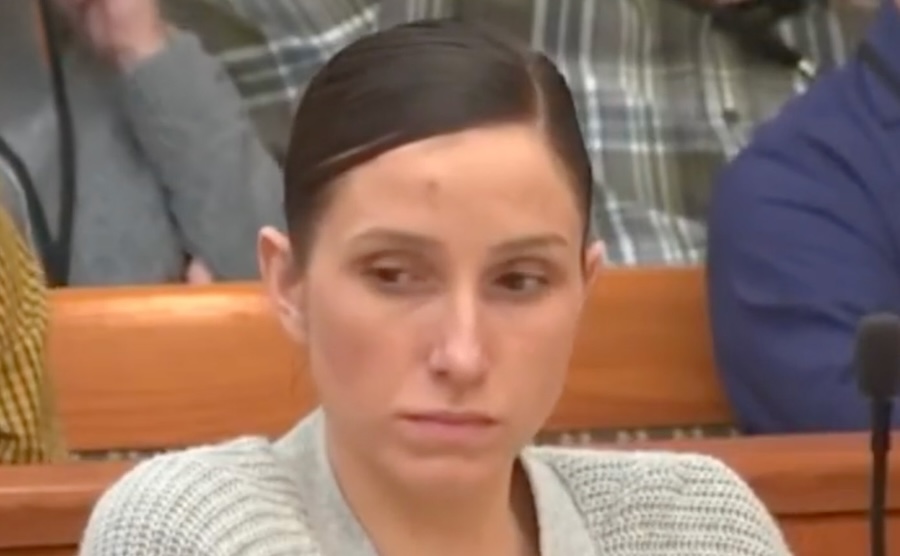
The fourth day of the Kouri Richins murder trial in Park City, Utah, delivered the week's most anticipated testimony as Carmen Lauber — the former housekeeper who allegedly procured illegal drugs for Richins — took the stand Thursday and described in detail four separate drug purchases she says she made at Richins' request in early 2022, just weeks before Eric Richins was found dead.
Lauber Describes Four Drug Transactions
Lauber, who cleaned Kouri Richins' home every other Friday through her aunt's housekeeping business for nine years, told jurors that Richins first approached her in early February 2022 asking if she could obtain pain medication for an "investor." Lauber connected with a woman named Susan Kohler and purchased small brown pills for $600, which she handed off directly to Kouri the following morning, according to her testimony as reported by East Idaho News.
For the second purchase, Lauber testified that Richins texted her saying the investor needed "something stronger." Lauber reached out to a contact on Facebook Messenger asking about pills — specifically "Roxy 30s or blues" — and was eventually connected with a man named Robert Crozier. She picked up $1,000 from a box in Kouri's Midway home, got a ride from a friend named Nancy Peterson, and met Crozier at a Maverik gas station in Draper. After waiting as long as 20 minutes, Crozier returned with a small clear baggie containing round, dark blue pills. Lauber buried them in the fire pit at the Midway property for Kouri to retrieve.
A third purchase followed a similar pattern. This time, according to Lauber, Richins told her the investor wanted the "Michael Jackson stuff." Lauber said she wasn't sure what that meant and Googled it, learning it referred to propofol. The pills Lauber ultimately obtained, she said, were picked up by Kouri directly from Lauber's driveway in Heber City.
The fourth and final transaction occurred after Eric Richins' death on March 4, 2022. According to ABC4, text messages shown in court captured Richins asking Lauber, "Still have your hook up?" Lauber said she agreed, went to pick up cash left under the doormat at Kouri's home in Kamas — only the money wasn't there. Richins then wrote Lauber a check for $1,300 with "construction clean Midway" written in the memo line. "I never cleaned a house ever in my life for $1,300," Lauber told the jury. She and a friend followed Crozier to a duplex in Draper, where he emerged with a baggie of blue pills. Lauber placed those pills in the closet of the Midway home at Kouri's direction.
A Charged Phone Call After Eric's Death
Lauber testified that when she learned Eric Richins had died, she called Kouri — with her friend Nick listening on speakerphone — and said, "Please tell me these pills were not for him." According to Lauber, Kouri replied, "No, they were not. Eric passed away from a brain aneurysm," as reported by the Deseret News. Lauber said learning later that Eric had actually died from a fentanyl overdose "hit hard." Wiping her eyes on the stand, she told the court: "If that's what happened, I needed to step up and take accountability for my part in this."
Defense Hammers Credibility on Cross-Examination
Defense attorney Wendy Lewis wasted little time attacking the reliability of Lauber's account, presenting her with three large binders containing transcripts of seven interviews Lauber gave investigators in April and May 2023 — totaling an estimated 10 to 15 hours of conversation — while she was incarcerated.
Lewis drew out a series of contradictions between those earlier statements and Lauber's courtroom testimony. In a 2023 interview, Lauber told detectives she had bought drugs three times before Eric died; today she testified the last purchase happened after his death. She had also previously said the money was left in the fire pit at the Midway property, not inside the house, contradicting her Thursday testimony that it was in a box in a closet. And in an earlier account, Lauber said she had never done a hand-to-hand exchange with Kouri — yet on the stand she described delivering pills directly to Kouri in her driveway.
When pressed, Lauber repeatedly said the discrepancies were because "it was a lot to process" while she was in jail, and that the events had occurred several years ago. She also confirmed she had told detectives her memory was "messed up and foggy" and that she had "fried her brain" through years of drug use, which stretched back to sixth grade, according to East Idaho News.
Lewis also highlighted the circumstances under which Lauber began cooperating. A recorded interview played in court captured a detective telling Lauber: "Give us the details that will ensure that Kouri will be convicted of murder." Another detective reportedly told her, "This whole case depends on you" and that cooperation would be a "giant get out of jail free card." At the time, Lauber was facing two five-year-to-life sentences in connection with her drug court violations.
Lewis further noted that Kouri Richins never directly asked Lauber for fentanyl — and suggested detectives introduced the word "fentanyl" into Lauber's account after telling her that Eric died from a fentanyl overdose. Lauber acknowledged that detectives did tell her the cause of death, but insisted the fentanyl connection came from her own knowledge of what she was obtaining, not from investigators.
Toxicology Evidence and Other Witnesses
Before Lauber took the stand, Dr. Brianna Peterson, a forensic toxicologist with NMS Labs, testified about Eric Richins' toxicology results. She confirmed fentanyl was present in his blood at 15 nanograms per milliliter — five times what she described as a potentially lethal concentration of 3 nanograms per milliliter, according to KUTV. The lab also detected acetylfentanyl, which Dr. Peterson said is often — though not always — associated with illicitly manufactured fentanyl, and norfentanyl. No hydrocodone or other opioids were found.
On cross-examination by defense attorney Wendy Lewis, Dr. Peterson acknowledged that it is possible Eric ingested fentanyl before consuming alcohol, and that she could not provide a precise timeline for when substances entered his system — a point the defense has used to suggest the fentanyl and alcohol were not necessarily combined in a single drink.
Earlier in the day, Chelsea Gipson, the lead crime scene technician, returned to the stand for a third consecutive day. She confirmed that approximately 10 hydrocodone pills were found in a laundry room cabinet, and that a letter was recovered from the foot of the master bed during a November 2024 search — a letter not found in any of the seven previous searches of the home. Investigators returned to the property most recently in February 2026, the day before trial began. Bryan Holden, a forensic scientist with the Utah Bureau of Forensic Services, testified that he tested 19 items for fentanyl and found none — and confirmed he was never asked to test an empty hydrocodone pill bottle found at the scene.
At the end of court, Judge Richard Mrazik addressed a note passed by a juror during the afternoon recess. A spectator had been sketching jurors and labeling the drawings by juror number; that person was removed from the courtroom and their sketchbook was confiscated.
What to Watch For
Carmen Lauber's cross-examination was still underway when court adjourned Thursday, and her testimony — along with the credibility battle it has ignited — continued into the Saturday special session (Day 6), where it was confirmed she did not return to the stand. The central conflict heading into Week 2, which begins March 2, remains whether Lauber's account holds up against Robert Crozier's testimony that he sold oxycodone, not fentanyl, and against the web of contradictions the defense has exposed in her statements. Judge Mrazik has also indicated he may elaborate on a denied mistrial motion — filed by an unknown party during Week 1 — when proceedings resume.