

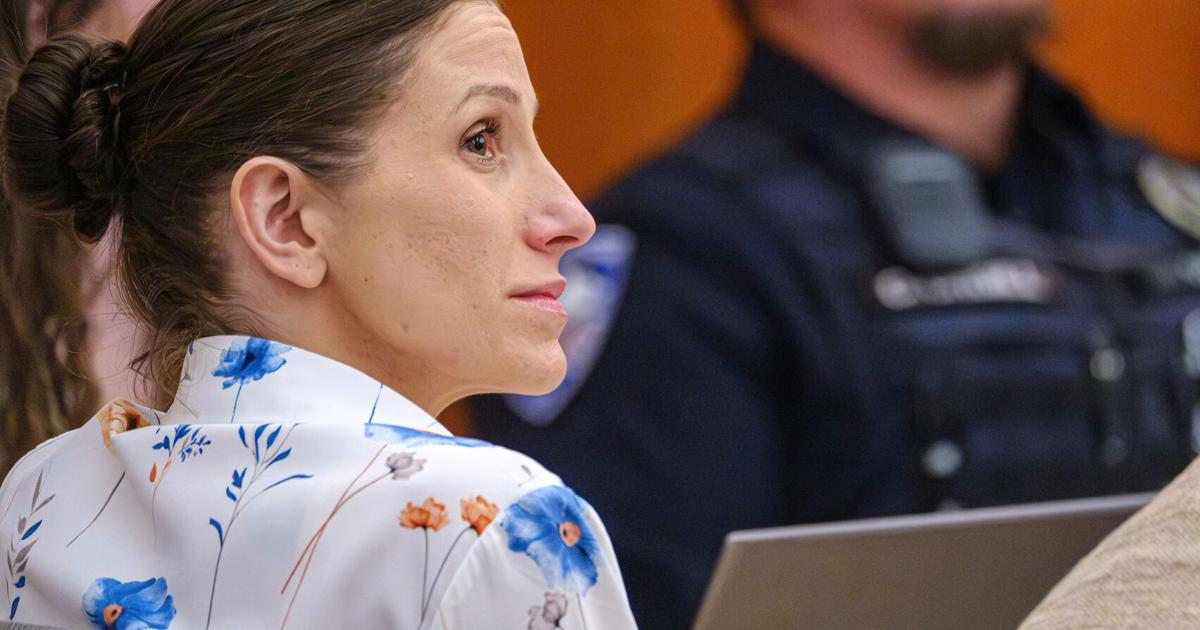
Two days after a Summit County jury convicted Utah mother Kouri Richins of murdering her husband with a fatal dose of fentanyl, the woman who led those deliberations is speaking publicly — offering the most detailed window yet into how jurors reached their unanimous verdict in less than three hours.
Jury Foreperson: 'We Came In Fully Loaded'
Laura, juror No. 2 and the foreperson in the Kouri Richins murder trial, sat down with ABC News' Good Morning America in an exclusive interview Wednesday, describing a deliberation room where doubt never gained a foothold.
"There was never a not guilty check with anything, with any element, nothing," Laura told ABC News. "Even though it was just three hours, I felt like we came into that deliberation fully loaded."
Laura said the jury's approach was methodical rather than emotional. "To evaluate the case and to look at the evidence we had to zoom in on these little bits of evidence and kind of ignore all the fluff and ignore the drama," she said.
The foreperson described her first impressions of Richins during the three-week trial as unsettling in their blankness. "She was kind of nondescript," Laura said. "She didn't really show that much emotion. I was trying to get some vibe from her and it was very hard to pick up any kind of vibe."
The Children's Book That Stunned the Courtroom
One moment stood out to Laura above the rest: the moment jurors learned that Richins had self-published a children's book about grief following her husband's death — a husband prosecutors alleged she had poisoned.
"Everyone just felt like they're hit with a truck," Laura told ABC News. "We're like, what? What the hell is this? It was so odd and so strange."
Richins had published the book in 2023 and, a month before her arrest in May of that year, appeared on Salt Lake City ABC affiliate KTVX's "Good Things Utah" to promote it, saying Eric Richins had died "unexpectedly" and that his death "completely took us all by shock."
Despite the weight of the evidence, Laura made clear that conviction did not come easily for her fellow jurors emotionally. "People were really sad, because they did not want to find her guilty," she said. "They were really hoping that she was innocent. And we couldn't come to that conclusion, and it was really heartbreaking."
The human cost was not lost on the panel. "This devastating reality that this family was torn apart and these poor kids will really basically never have a dad or mom," Laura said, referencing Richins' three young sons.
Legal Analysts Dissect the Prosecution's Case
As the foreperson's account emerged, legal analysts offered post-verdict assessments of what drove the conviction.
CNN Trial Correspondent Jean Casarez, herself an attorney who closely covered the trial, told CNN that financial motive was central to how jurors processed the evidence. "A motive gives the 'why' — why an alleged crime was committed by the defendant sitting in the courtroom. Juries want to know why. That gives them a reason to convict," Casarez said.
That assessment was borne out in the verdict form itself. According to CNN, jurors unanimously agreed that both the murder and attempted murder of Eric Richins were committed for financial benefit — a finding Casarez said showed "the money was really paramount in those jurors' minds."
Prosecutors had built a detailed financial portrait of Richins. A forensic accountant testified for a full day that Richins' real estate business was in collapse at the time of her husband's death, according to CNN. Eric Richins' life was insured for more than $2.2 million through several policies, including one his wife was convicted of fraudulently applying for. Ten days after that policy took effect, the jury found, Richins attempted to kill her husband on Valentine's Day. He died the following month.
The Witnesses Who Made — and Nearly Broke — the Case
Casarez identified the prosecution's housecleaner witness, Carmen Lauber, as potentially decisive. Lauber testified that Richins had asked her for drugs multiple times in early 2022, and that she purchased pills from a man named Robert Crozier at a gas station on two occasions before Eric Richins' death and once shortly after.
The defense attacked Lauber's credibility aggressively, citing her history of drug use, inconsistencies in her statements, and the immunity deal she received in exchange for her testimony. "If the jury hadn't believed her, there may not have been a conviction," Casarez said.
What saved Lauber's testimony, according to Casarez, was cell phone data. Records showed both Lauber's and Crozier's phones were near the gas station on February 11 and February 26, 2022 — days before the attempted murder and Eric Richins' death. Crozier and Lauber's phones appeared near the station again on March 9, 2022. "They were pivotal dates, pivotal times," Casarez said, adding the digital evidence "added so much credibility to the circumstantial case."
Prosecutors also presented internet searches made on a new phone Richins began using in April 2022, after law enforcement seized her original device. Among the searches, according to CNN: "can fbi find deleted messages," "what is a lethal.dose.of.fetanayl," and "if someone is poisned what does it go down on the death certificate as."
The 'Walk the Dog' Letter
Legal analyst Hershon pointed to a letter found in Richins' jail cell in September 2023 as among the most damaging evidence of the trial. Prosecutors alleged the so-called "Walk the Dog" letter laid out a fabricated narrative Richins wanted her brother to pass to her then-attorney — a story suggesting Eric Richins had bought drugs in Mexico and later asked his wife to purchase some from Lauber.
"What she put in that letter makes everything else that happened in the trial more believable, from the prosecutor's point of view," Hershon said, according to CNN. "Because all of these other things, it's not just another coincidence, another coincidence, another coincidence. It's now saying this is a pattern, this is a scheme, this is a plan of action that she put together step by step by step."
What Comes Next
Richins remains in Summit County Jail ahead of sentencing, which is scheduled for May 13, 2026 — the day Eric Richins would have turned 44. Judge Mrazik will review a pre-sentence investigation report and hear victim impact statements from Eric's family before deciding between life without the possibility of parole or a sentence that includes a parole pathway. The aggravated murder charge carries a minimum of 25 years to life.
Former Utah prosecutor Nathan Evershed has noted that a thorough appeal can take up to a year to prepare, with the case likely eventually reaching the Utah Supreme Court or Court of Appeals. One potential appellate argument flagged by Evershed is venue — the defense had sought to move the trial from Summit County to Salt Lake County. Meanwhile, civil proceedings involving Utah's slayer statute, which bars a killer from inheriting from their victim, continue in parallel. Whether prosecutors will proceed with a separate 26-count financial crimes case filed against Richins in June 2025 also remains an open question.