

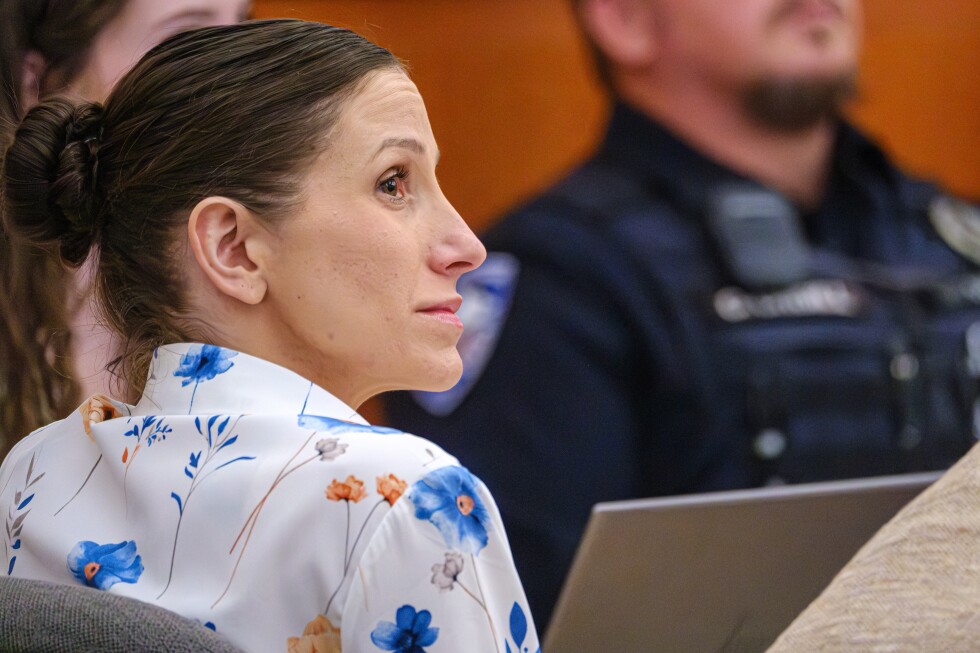
The first week of Kouri Richins' murder trial concluded Friday in Park City, Utah, with the credibility of the prosecution's most important witness under sustained attack — and the alleged drug supplier taking the stand for the first time to deliver testimony that complicated the state's case against the Utah mother accused of poisoning her husband with a fatal dose of fentanyl.
Lauber's Cross-Examination: Memory, Motive, and Inconsistencies
Carmen Lauber, the Richins family's former housekeeper and a central figure in the prosecution's case, returned to the witness stand Friday morning as defense attorney Wendy Lewis continued a grueling cross-examination that stretched across two days. Lauber has testified that she purchased illicit drugs for Kouri Richins on four occasions in early 2022, including fentanyl pills she says were delivered to Richins' properties in Heber City and Midway.
But Lewis methodically used transcripts from seven jail interviews conducted between April and May 2023 to highlight what she characterized as a shifting, unreliable account. Among the inconsistencies Lewis pressed Lauber on: the number of drug purchases she initially reported to investigators (three, not four), where pills were left after purchases, and whether Kouri Richins ever specifically asked for fentanyl by name.
In one of the morning's most significant exchanges, Lewis asked Lauber directly: "Kouri never asked you for fentanyl, true?"
"Yes," Lauber replied, according to live updates from East Idaho News.
Lewis also highlighted a recorded jail interview in which an investigator told Lauber her drug court deal could be revoked — and another investigator added: "He means, like, give us the details that will ensure Kouri gets convicted of murder." Lewis argued that Lauber, who faced potentially severe prison time on separate drug charges, had strong incentive to tell prosecutors what they wanted to hear.
Lauber pushed back on that characterization. According to KUTV, she maintained throughout that she came forward because she felt guilty when she learned Eric Richins had died of an overdose. "That hit hard," she testified. "Only for the fact that, if that's what happened, I needed to step up and take accountability of my part in this."
Lewis also pointed out that Lauber was testing positive for methamphetamine in late January, mid-February, and early March 2022 — the period during which she claims to have made the drug purchases for Richins. "You were high that whole time, February, March '22?" Lewis asked, according to CNN. "Not the whole time, no," Lauber responded, acknowledging she was "using very regularly."
The judge ruled that several transcript portions could not be admitted wholesale due to hearsay concerns, though he indicated some sections with proper foundation could be used. Prosecutor Brad Bloodworth conducted redirect examination, eliciting from Lauber that she has been sober since her April 2023 arrest and that her memory has improved as she got clean. Lauber stepped down from the stand Friday afternoon, though attorneys noted she may be recalled.
The Drug Dealer Takes the Stand
Robert Crozier — the alleged supplier at the center of the drug chain prosecutors say led fentanyl to Eric Richins — took the witness stand Friday for the first time, testifying under a grant of immunity, according to East Idaho News live updates.
Crozier's testimony added a significant complication to the prosecution's narrative. He testified that the pills he sold to Lauber — referred to as "M30s" and "blues" — were what he understood in early 2022 to be oxycodone, not fentanyl. He said he met Lauber at a Maverik convenience store in Draper and that those were the only times they met.
When asked whether Lauber requested blues or fentanyl specifically, Crozier said he did not remember the conversation. He also acknowledged that he did not recall much of his 2023 interview with the Summit County Sheriff's Office because he was in Davis County Jail at the time and was detoxing. Defense attorney Wendy Lewis began cross-examination of Crozier before the court recessed for the week.
Crozier's testimony is notable because, as KPCW reported, defense attorneys had previously disclosed that Crozier recanted a prior account that had corroborated Lauber's story — a shift that came weeks before trial began. The distinction between oxycodone and fentanyl is critical: street "M30" pills are frequently pressed with fentanyl rather than oxycodone, but Crozier's stated understanding at the time could affect how jurors interpret the chain of knowledge between seller, buyer, and alleged end user.
A Brief but Pointed Witness: Anna Isbell
Anna Isbell, described as the longtime girlfriend of deceased handyman Hayden Jeffs, also testified briefly Friday. According to East Idaho News, Isbell said she was with Jeffs on January 22, 2022, when Kouri Richins called and asked if he had "something for a client." Jeffs declined.
Defense attorneys used Isbell's testimony to advance another thread in their case: a narrative of witness intimidation by investigators. Lewis pointed to a text exchange in which a detective allegedly threatened Isbell with a warrant and a "catch pole" for her dog during the investigation — an episode the defense is using to suggest law enforcement applied improper pressure on witnesses throughout the case.
Case Background
Kouri Richins, 35, a Kamas-area realtor, is charged with aggravated murder, attempted aggravated murder, insurance fraud, and forgery in connection with the March 4, 2022 death of her husband Eric Richins, 39. Prosecutors allege she spiked his Moscow mule cocktail with a lethal dose of fentanyl and had previously attempted to poison him with a fentanyl-laced sandwich on Valentine's Day. Eric Richins had approximately 15 nanograms per milliliter of fentanyl in his blood at autopsy — five times the minimum lethal dose — according to forensic toxicologist Dr. Brianna Peterson, who testified Thursday. Acetylfentanyl, a marker typically associated with illicit manufacturing, was also detected.
Richins has pleaded not guilty to all charges. Her defense contends she is innocent and that the investigation was driven by her in-laws, who refused to accept that Eric may have been self-medicating with drugs he obtained independently. A conviction on the aggravated murder charge could result in a life sentence.
The trial, presided over by Judge Richard Mrazik in Summit County's Third District Court, is scheduled to run five weeks and conclude on March 27.
What to Watch Next Week
When trial resumes Monday, Robert Crozier's cross-examination by the defense will be a key moment to watch — particularly how Lewis pursues the question of whether he ever told Lauber the pills were fentanyl. Prosecutors will also have an opportunity to rehabilitate Crozier on redirect. Lauber's potential recall remains on the table. Jurors will continue weighing a case in which the prosecution's drug-supply chain hinges heavily on the testimony of two witnesses — one a self-described recovering addict testifying under immunity, the other a dealer who says he thought he was selling oxycodone.