

Thirty-three days after 84-year-old Nancy Guthrie was abducted from her Tucson, Arizona home, investigators are pursuing a striking new digital forensics angle — asking neighbors whether they experienced internet service disruptions the night she vanished — while a former FBI special agent publicly raises the possibility of an international organized theft ring connection and Sheriff Chris Nanos signals his department is moving past one of its most high-profile investigative detentions.
Investigators Canvass Neighborhood for Signs of a Wi-Fi Jammer
In a development first reported by NBC correspondent Liz Kreutz, investigators returned to Guthrie's neighborhood on March 6 and questioned residents about whether they noticed any internet service disruptions or "glitches" in the early morning hours of February 1 — the night authorities believe Nancy Guthrie was kidnapped. Three homeowners confirmed to Kreutz that investigators approached them with the question; none were able to confirm anything unusual, as they were either asleep or away at the time.
Neither the Pima County Sheriff's Department nor the FBI confirmed the canvassing detail on record. PCSD declined to confirm or deny whether a Wi-Fi jammer was suspected, saying only that investigators are "examining all angles," according to NBC's reporting. The significance of the inquiry is considerable: if devices across the surrounding area dropped offline simultaneously around the time Guthrie's doorbell camera was disconnected at 1:47 a.m., it could suggest deliberate electronic interference rather than a coincidence or technical failure — a hallmark of sophisticated, premeditated criminal operations.
The timeline already established by investigators is precise. According to the Sunday Guardian, Guthrie's doorbell camera disconnected at 1:47 a.m. on February 1. Surveillance footage detected a dark figure walking toward the house at 2:12 a.m. By 2:28 a.m., her pacemaker had lost its connection with her iPhone application.
Sheriff Nanos: 'We're Moving On' From Luke Daley Detention
In an interview with true crime podcaster Briana Whitney, Sheriff Nanos issued a blunt four-word assessment of the February 13 SWAT operation that resulted in the detention of Luke Daley: "we're moving on." The sheriff provided additional context around the warrant process, stating that probable cause was reviewed and approved at multiple levels before the operation was executed.
"What I will say is, we had what we believed to be probable cause to take action against both those individuals and the residences they occupied," Nanos said, according to the interview. "That probable cause that we felt was strong was given to the US attorney, the county attorney, and a magistrate, a judge. They agreed that, yes, here's a warrant, go perform your duties. That court order, that warrant, in both cases, was served and we got what we got from it and we're moving on."
Nanos also confirmed the name of Daley's mother as Mary Daley. The sheriff's remarks underscore that the detention was part of routine investigative procedures rather than a confirmed breakthrough, and that law enforcement considers that particular avenue exhausted.
Former FBI Agent Raises Chilean Organized Theft Ring Theory
Former FBI Special Agent Jennifer Coffindaffer publicly raised the possibility of a Chilean organized theft ring connection to the Guthrie disappearance in a post on X. Coffindaffer stated that individuals tied to such rings had been "charged for many high-profile burglaries of athletes like Travis Kelce that we were tracking," and pointed to what she described as visual similarities between the surveillance appearance of individuals linked to Chilean theft rings and the suspect footage in the Guthrie case.
"What I find eerie is how the Chileans dress and how these rings are still operating in affluent communities like Nancy Guthrie's," Coffindaffer wrote, while acknowledging the cases "were not necessarily connected" but noting that "the FBI is likely considering everything at this point just like we are." Investigators have not confirmed any link to Chilean organized crime, and the theory remains in the realm of public commentary rather than official investigative direction.
Cartel Theory Surfaces in Media; Investigators Have Not Confirmed
Separately, RadarOnline.com reported that an anonymous tipster reached out to an entertainment news outlet claiming to have seen Nancy Guthrie south of the U.S.-Mexico border approximately five days prior. The tipster's messages, which reportedly demanded "millions" in Bitcoin for information, were turned over to the FBI, which has reportedly been in contact with Mexican authorities, according to RadarOnline. Private investigator Jason Jensen suggested to the outlet that the abduction could be "retaliation against the United States' attacks on the cartel's distribution boats in the Caribbean and affecting their fentanyl trade." Retired ATF agent Jim Cavanaugh noted that Tucson sits approximately 70 miles from the southern border.
It is important to note that investigators have not confirmed any cartel connection, the anonymous tips have not been independently verified, and the sourcing for several of these claims originates with unnamed individuals. The FBI has not publicly commented on the Mexico angle.
Attorney: Investigation in Its 'Most Critical' Phase
Attorney Peter S. Christiansen told Newsweek that the investigation is now entering its "most critical" phase, with law enforcement "actively building a narrative that must eventually withstand the scrutiny of a courtroom." Christiansen emphasized that the evidentiary focus is likely on "authentication and traceability," and warned that procedural missteps in a case of this profile could jeopardize future prosecution.
"The public expects immediate breakthroughs when leads are mentioned, but in reality, the FBI and local police have to balance urgency with evidentiary integrity," Christiansen told Newsweek. "Every piece of digital and physical evidence must be properly collected and preserved to avoid due process issues down the line."
Sheriff Nanos echoed the deliberate approach in a separate interview with NBC News, confirming that investigators are withholding information from the public. "We have information on this case that we think is going to hopefully lead us to solving this case. But it takes time," Nanos said. He also offered the first on-record characterization of the scale of vehicle analysis underway, confirming that investigators are examining the Ring camera vehicle alongside "hundreds of thousands of other vehicles that were out driving that time of day."
Mixed DNA Remains a Central Challenge
In a KVOA interview, Nanos reiterated that gloves beyond the now-ruled-out black glove have been sent to a laboratory in Florida for DNA testing, but that results will take time due to the complexity of mixed DNA samples. "It's a challenge because we know we have DNA, but now we have to deal with that mixture and how we're going to separate it," Nanos said. The mixed DNA, found inside Guthrie's home and not belonging to her or anyone in close contact with her, remains the primary biological evidence under active analysis.
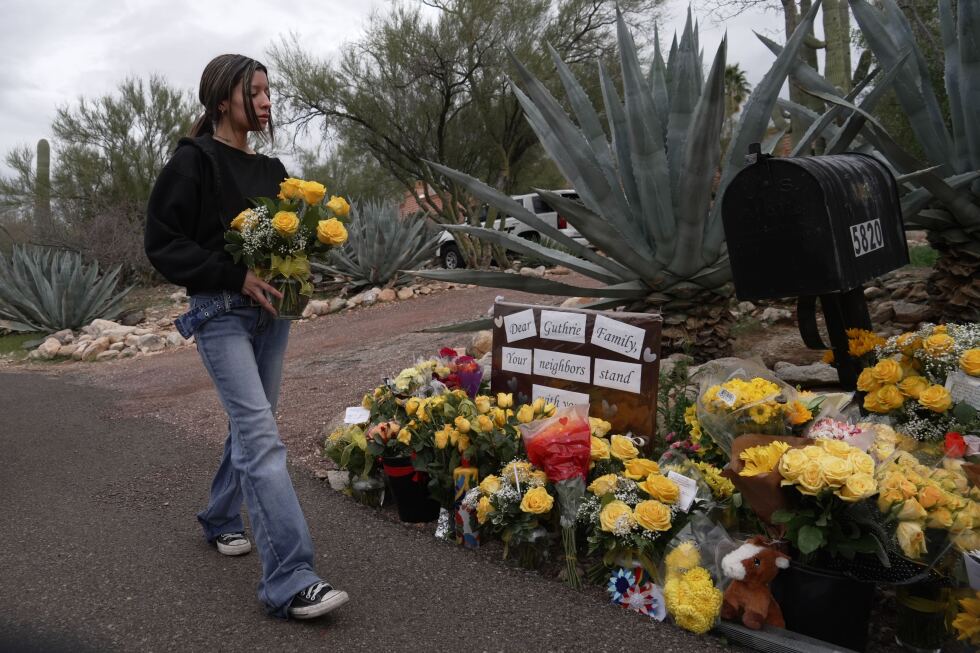
Savannah Guthrie posted a message on Instagram Monday, writing: "We feel the love and prayers from our neighbors, from the Tucson community and from around the country. Please don't stop praying and hoping with us. Bring her home."
What to Watch For Next
The Wi-Fi jammer canvassing represents a significant new direction that investigators have neither confirmed nor denied — any official acknowledgment of that theory would mark a major development. The Florida lab's mixed DNA results remain the most consequential pending forensic finding. Whether investigators publicly confirm or rule out the international organized crime theories — Chilean theft rings or cartel involvement — will also be closely watched. The $1 million family reward and the FBI's separate $100,000 reward remain active; anyone with information is urged to call 1-800-CALL-FBI or contact PCSD at 520-351-4900.